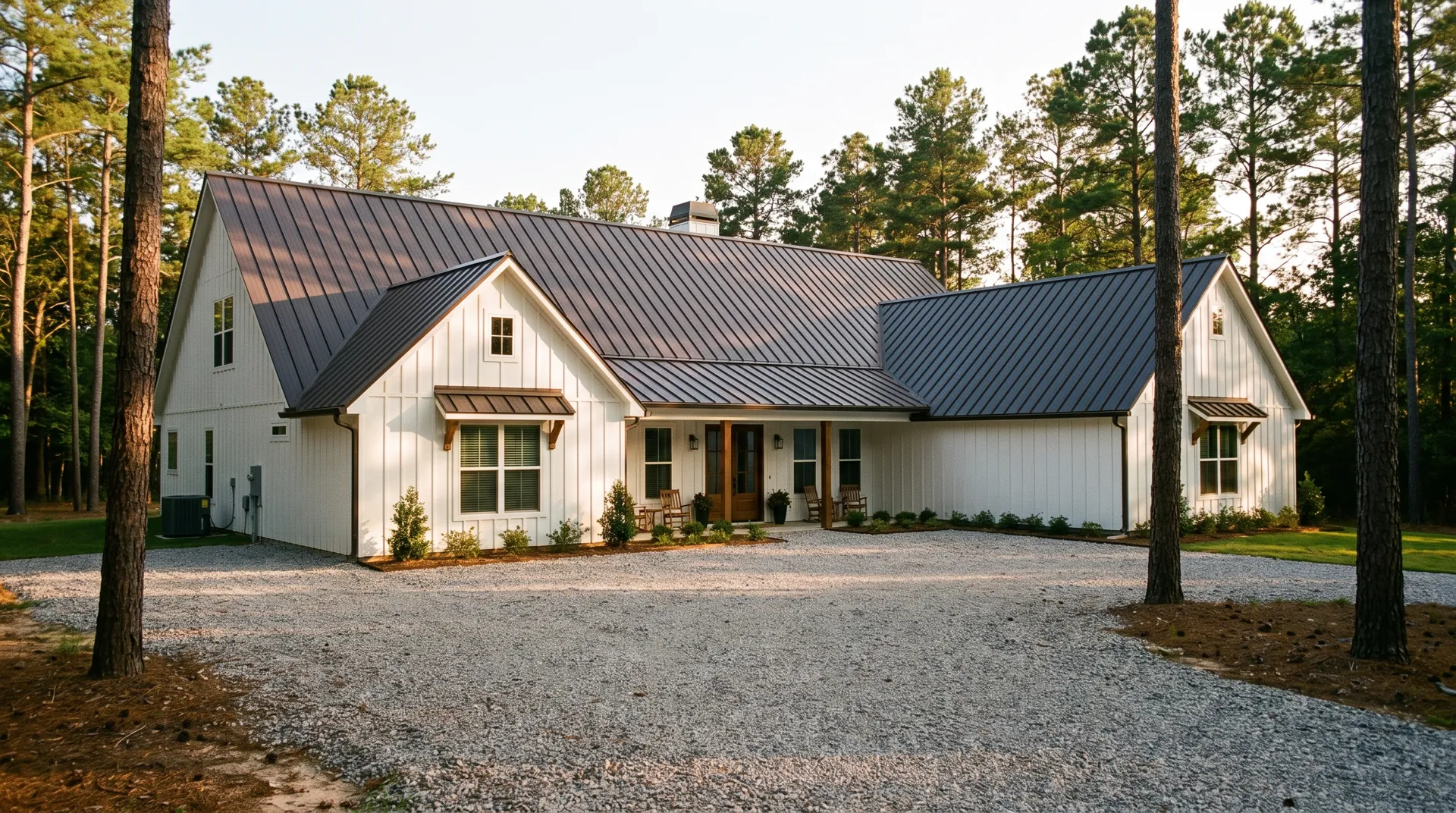
Ten years ago this wasn't a question in Conroe subdivisions — you got shingles. Now standing seam is on new builds in Grand Central Park, on half the lake houses, and on most of the acreage homes out FM 1484 and FM 1488. Both are good roofs. Here's how they compare on the things that matter here.
| Class 4 architectural shingle | Standing-seam metal | Stone-coated steel | |
|---|---|---|---|
| Installed cost, typical home (2026) | $13,500 – $23,000 | $28,000 – $48,000 | $30,000 – $45,000 |
| Realistic Texas lifespan | 25 – 30 years | 40 – 60 years | 40 – 50 years |
| Hail | Class 4 rated; survives typical hail | Resists cracking; dents cosmetically | Class 4 rated; hides dents |
| Insurance | Wind/hail discount for Class 4 | Often a cosmetic-damage exclusion | Usually gets the Class 4 discount |
| Summer cooling | Baseline | 10–25% less cooling with a light Kynar color | 5–15% less |
| Pine needles & algae | Needles catch; algae-resistant granules help | Sheds needles; no algae | Sheds needles; no algae |
| Noise in rain | Quiet | Slightly louder over a deck; fine with insulation | Quiet |
| HOA / covenant | Always allowed in an approved color | Allowed in many communities with an application; not all | Usually allowed (looks like shingle or tile) |
| Install time | 1 – 2 days | 2 – 4 days | 2 – 4 days |
When shingle wins
When the budget is the budget; when you expect to sell within ten years (buyers rarely pay the full metal premium back); when the HOA won't allow metal; when hail claims are part of your plan and you want the straightforward Class 4 discount without cosmetic-exclusion fine print.
When metal wins
When you're staying twenty years; when the house is on the lake or under heavy pines; when summer cooling is a real cost (a big two-story with the AC running from May to October); when you're tired of replacing a roof every fifteen years; when it's an acreage home with a barn and a shop that are already metal.
The middle: stone-coated steel
Decra and Unified Steel panels look like architectural shingle or tile from the street, carry a UL 2218 Class 4 rating, hide hail dents in their texture, are quiet in rain and pass most HOA reviews. They cost about what standing seam costs. For a lake house whose owner worries about the cosmetic-damage exclusion, they're often the answer.
Two Texas-specific cautions on metal
Cosmetic-damage exclusions. Many Texas policies now add an endorsement excluding cosmetic hail damage on metal roofs — dents that don't leak aren't covered. Read the endorsement before you choose metal; on a lake house facing the hail track it can matter. Metal over shingles. Standing seam can go over one sound layer of shingles and save the tear-off, but not over two layers, soft decking or an active leak. We'll tell you which you have.
Related questions
Is a metal roof worth it in Conroe?
If you're staying long enough to use the lifespan and the cooling savings — roughly ten years or more — and the HOA allows it, usually yes. For a shorter hold, a Class 4 shingle roof gives most of the storm benefit for half the money.
Will metal make my house hotter or cooler?
Cooler, with a Kynar finish in a light or medium color and a ventilated attic. A dark bronze roof is still cooler than a black shingle. Add a radiant barrier and a ridge vent and the difference is noticeable on the July bill.
Does a metal roof lower my insurance?
Sometimes: stone-coated steel usually qualifies for the Class 4 discount; bare standing seam sometimes does. The catch is the cosmetic-damage exclusion. Ask your agent about both before you buy.
Can lightning hit a metal roof?
A metal roof doesn't attract lightning; if it's hit, it conducts the strike to ground more safely than a shingle roof and doesn't burn. It's not a reason to avoid metal.
Will an HOA in The Woodlands or Woodforest allow metal?
Some villages and sections do, with an application and an approved dark color; some don't. We check the covenants and submit the application before you order anything.
What about R-panel on the house?
It's the value metal — $16,000 to $28,000 — and fine on ranch houses, farmhouses and acreage homes. The exposed fasteners need their washers checked every 10 to 15 years, and most subdivision HOAs don't allow it on the main house.